NBSS Featured in Monocle Magazine

NBSS was profiled in the April 2024 issue of Monocle Magazine, on the ways we are helping keep American craft alive. Meet the students stepping away from screens and turning their hands to traditional craftsmanship.
“We sit in a city that has world-class higher education and a long, proud, blue-collar history. We are a kind of bridge between those very powerful identities and we attract people from both of those worlds. It makes North Bennet very special. There’s an interplay here that I don’t know exists elsewhere.”
Here’s an excerpt from the article by Will Higginbotham and Christopher Lord:
“’There’s something fundamentally human and satisfying about working with one’s hands,’ says Sarah Turner, president of the North Bennet Street School (NBSS), which was founded in 1881.
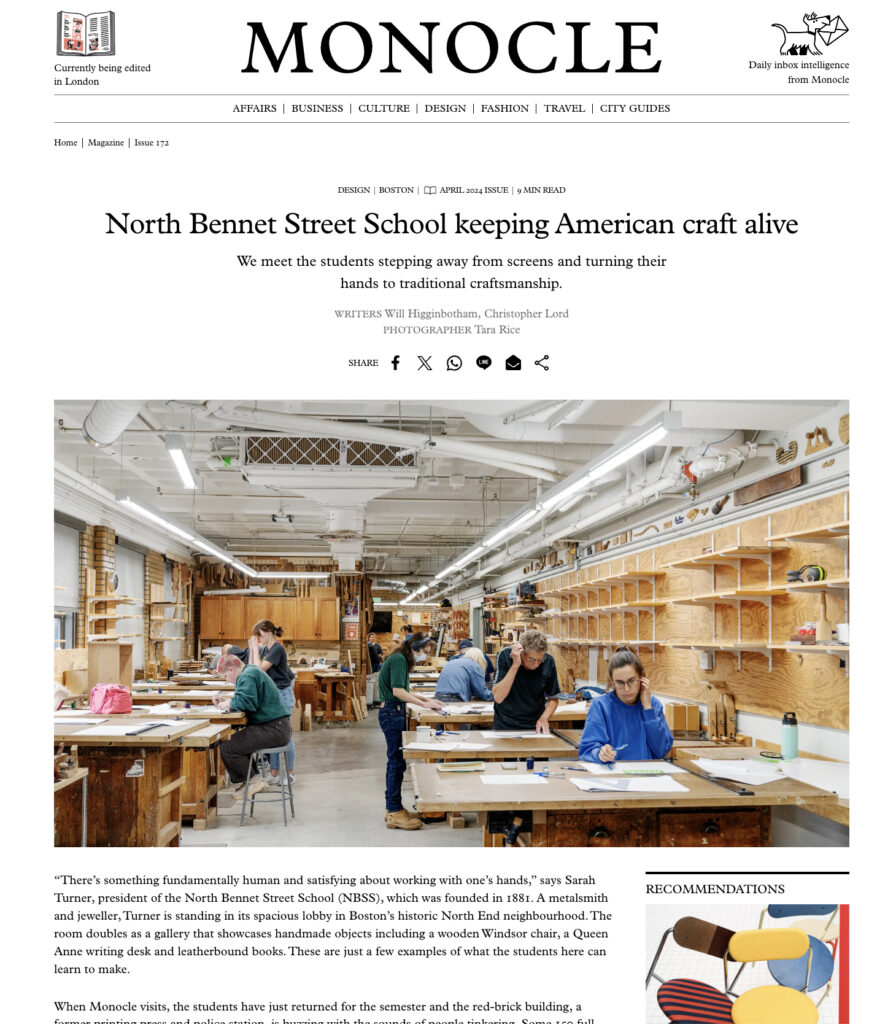
…When Monocle visits, the students have just returned for the semester and the red-brick building, a former printing press and police station, is buzzing with the sounds of people tinkering. Some 150 full-time students are enrolled in the school on programmes in everything from bookbinding to violin-making and repair, preservation carpentry, furniture-making, piano technology, jewellery and locksmithing.
Courses at the NBSS are taught using the Sloyd Method, a 19th-century Scandinavian teaching system designed to cultivate hand skills. The school’s motto – “A good life, built by hand” – reflects this tactile approach. Any modern machine tool that’s used in these workshops is there to supplement handheld ones, not replace them. “We are creating a generation of people who are capable of using the latest technology but who can also use the tried-and-true methods of old-fashioned hand craftsmanship,” says Turner.
As niche and Old World as it sounds, inquiries into courses at the NBSS have increased by 45 per cent over the past three years. Turner has her suspicions as to why. “People are reconsidering how they want to live and we shine a light on an appealing alternative.” Students, she says, are attracted to the idea that it’s possible to swap today’s screens, offices and tertiary academic courses for a seemingly bygone way of life: plying hands to a trade and building a viable career in the wood shop or bindery.”
First, though, one must become a master craftsperson. No former experience is necessary but those who are admitted must commit themselves to punctuality and put in the hours – sometimes 10 hours a day, five days a week. Despite these rigours, they arrive from across the US and range from recent high school graduates and career-changers to retirees who are ready for reinvention.”
Read the full article on their website, or download a pdf from the magazine.

