Binding Craft and Experience

The Driscoll Family & von Clemm Fellowship at the Boston Athenaeum has provided Bookbinding graduates with invaluable conservation experience for two decades
For the last 22 years, the Driscoll Family & von Clemm Fellowship at the Boston Athenaeum has helped North Bennet Street School Bookbinding students hone their craft in an iconic setting. The Athenaeum is one of the nation’s oldest independent libraries. Inside, five galleried floors house an extraordinary collection of rare books, manuscripts, papers, maps, and fine art—much of it dating back to the Revolutionary War. While many Bostonians know of the Athenaeum, few have stepped beyond the glass doors in its light-filled basement that lead into a treasure trove of knowledge: the Boston Athenaeum Conservation Lab, where each year’s fellow works each day. The full-time, competitive fellowship is awarded to one recent NBSS Bookbinding (BB) graduate each year and acts as a launching pad to expansive future careers.
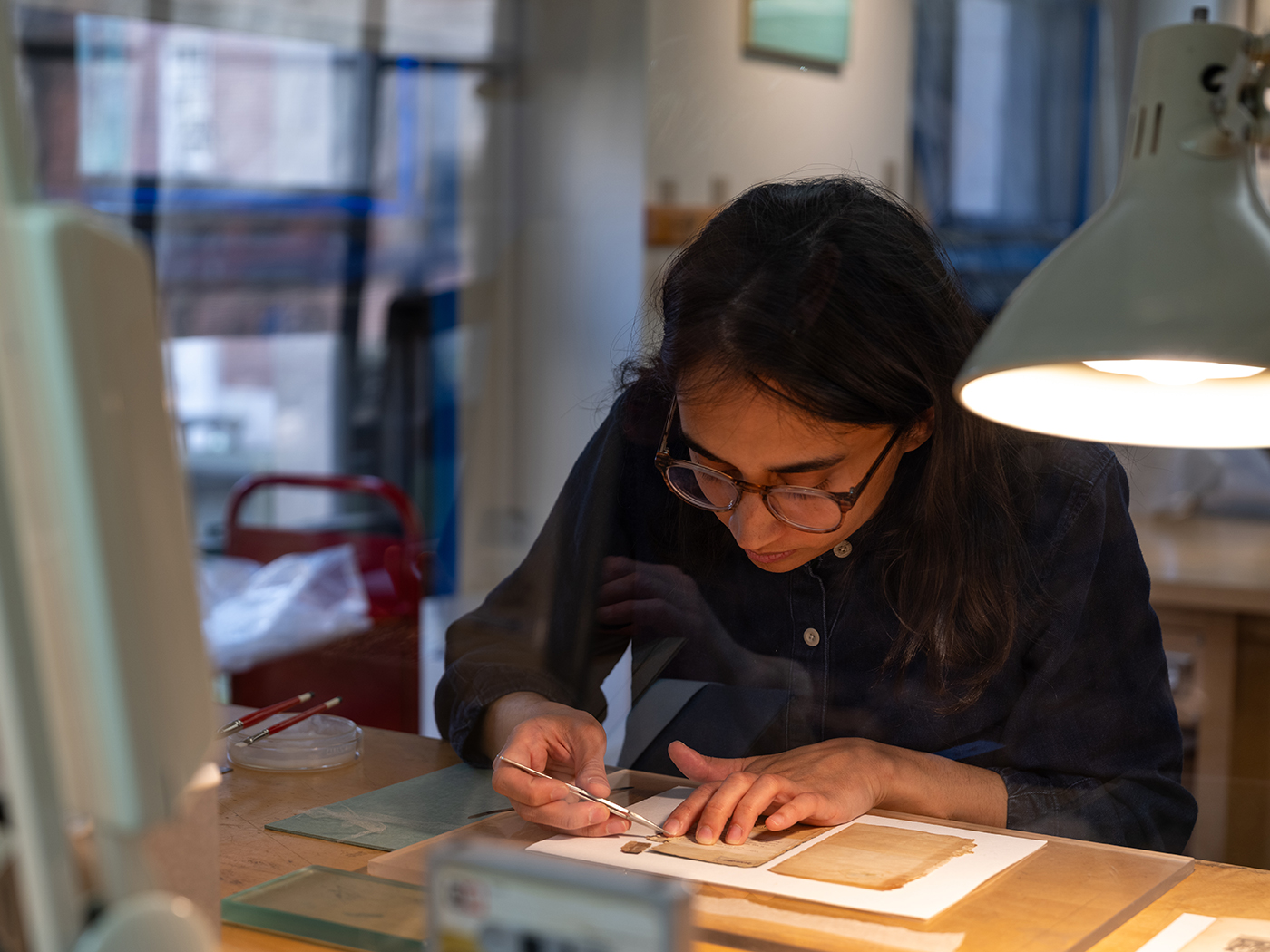
In the lab today, India Patel BB ’24 is repairing a 1647 edition of Selenographia by Johannes Hevelius, a leather-bound volume that contains arresting early depictions of the moon’s surface and includes a volvelle, a rotating astronomy chart. The book’s conservation treatment plan involves stabilizing the volvelle and strengthening the joint of the binding using a technique that Graham Patten, the lab’s senior conservator, conceived and published on.
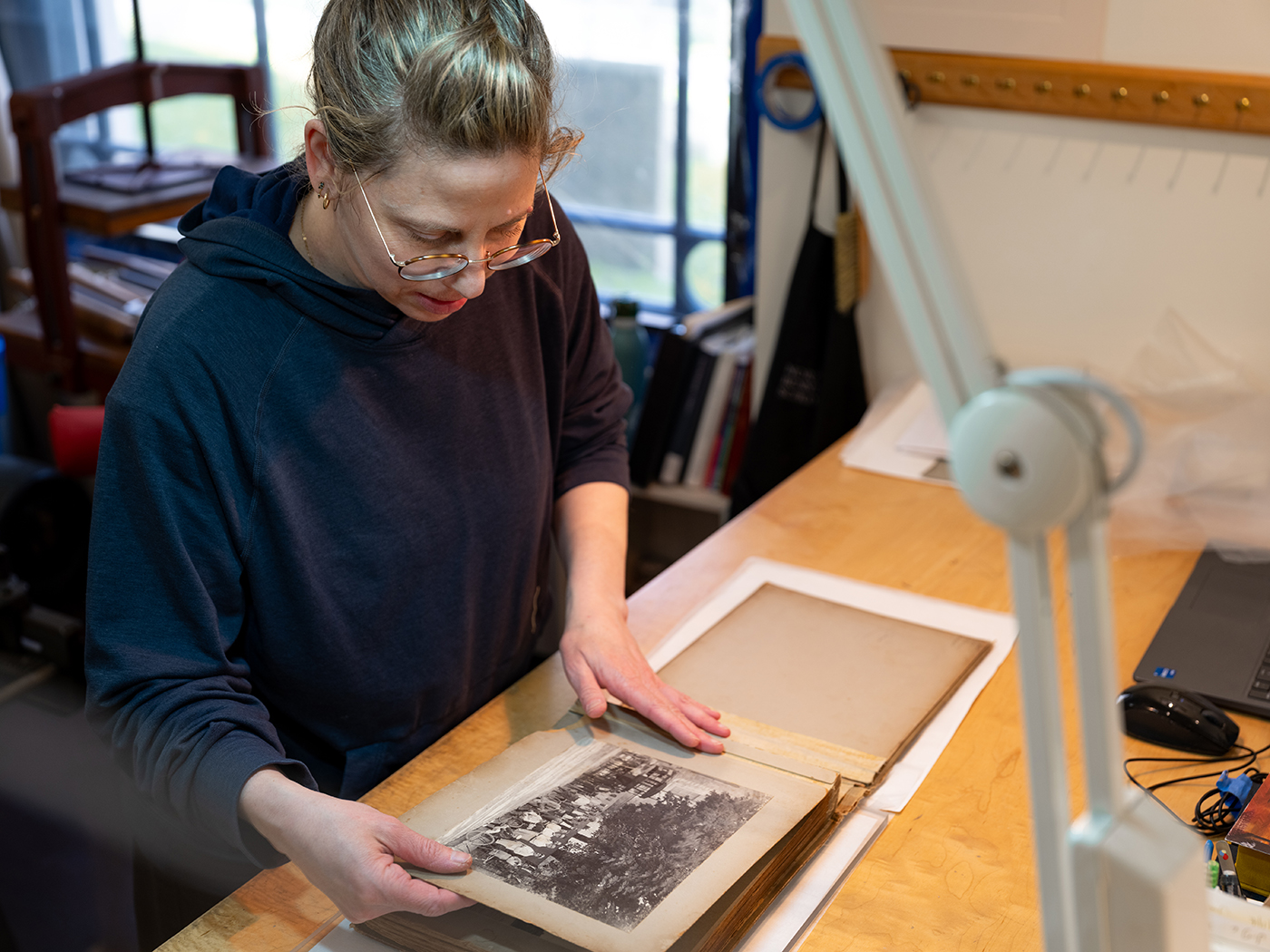
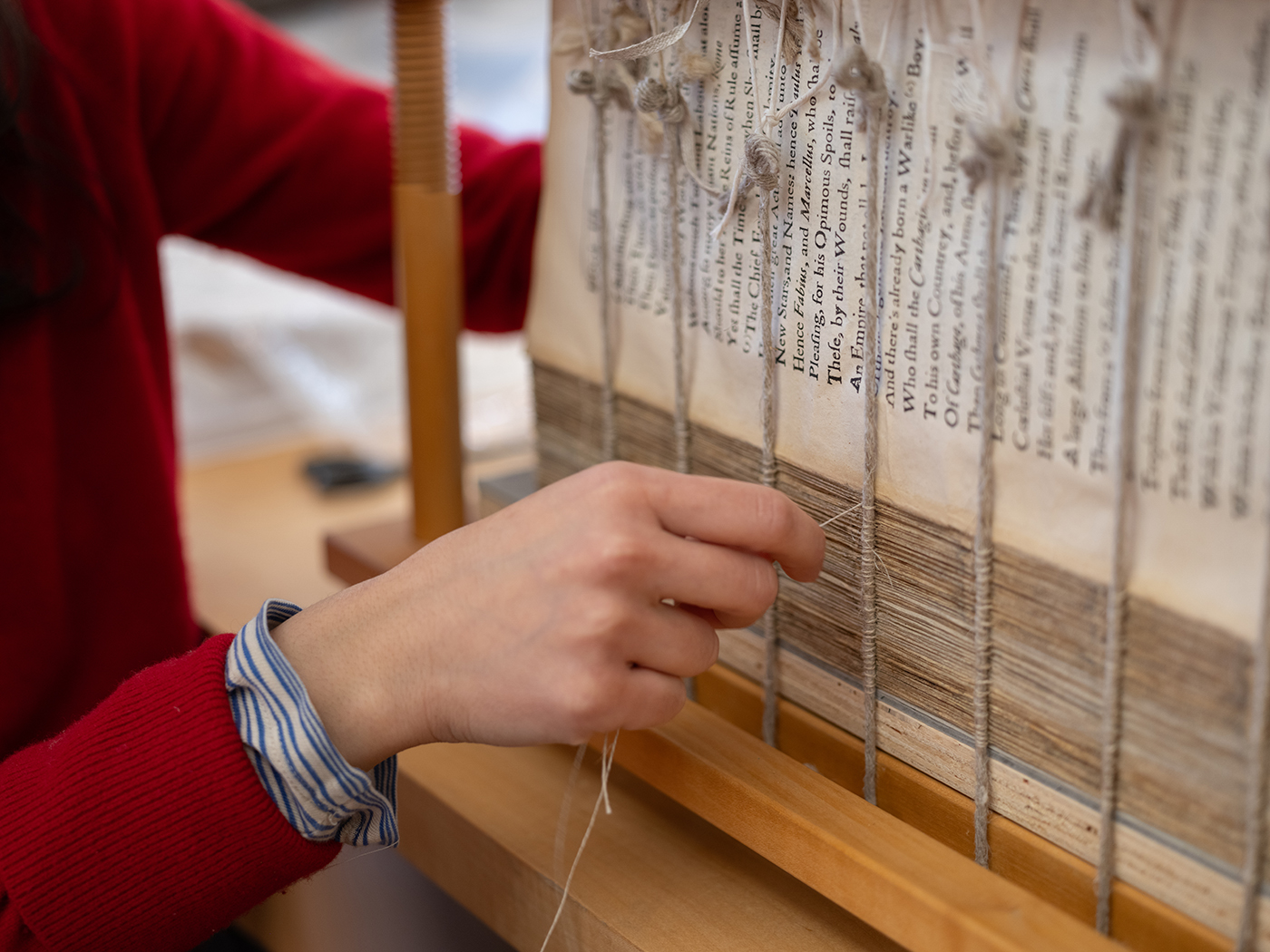
Graham has been at The Athenaeum for seven years—and for the last four, he’s also directed the fellowship program. India was the 2024 fellow and has stayed on as temporary conservation technician while also working as a Teaching Assistant at NBSS. At the next bench over is this year’s fellow, Yaara Buksbaum BB ’25, currently treating a 19th-century photograph album documenting the history of a Boston cycling club. She explains that the challenge of this project was to preserve and strengthen the boards authentically without making the album look like it was crafted in 2026. “Our aim in conservation is to promise a book longevity and to slow deterioration, and to make it possible to handle it safely in the present.”
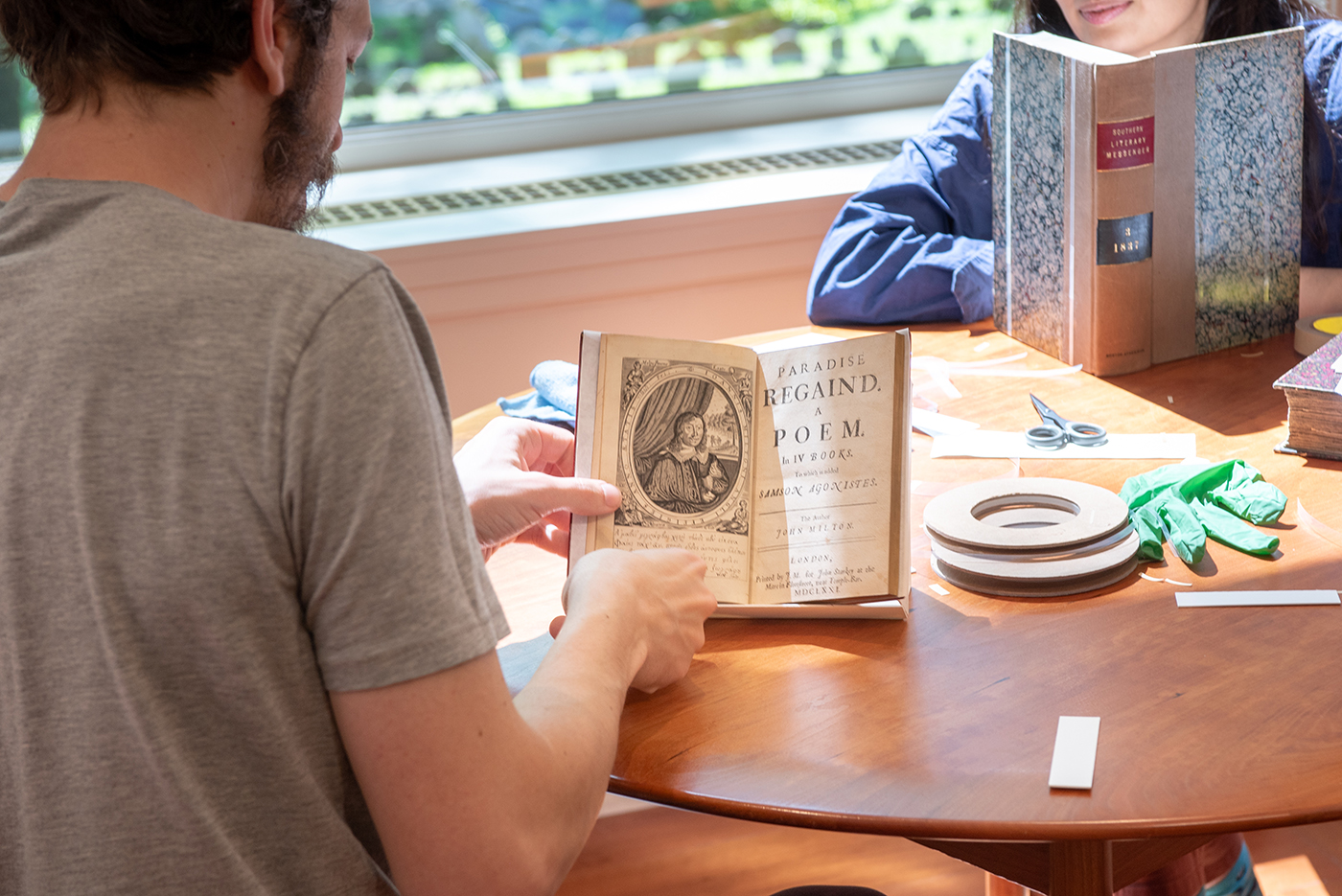
“The fellowship focuses on treating objects in Special Collections and spending time at the bench,” Graham says, “but we also call on each fellow to help out with exhibition preparation, creating custom housings for collections materials, and doing all kinds of preventative conservation work.”
That breadth of experience is precisely what motivated the program’s founding more than two decades ago. What began as a 6-month internship supported by funding from Lisa von Clemm—a dedicated supporter of the Bookbinding program who passed away in 2016—was eventually paired with the Driscoll family’s support to create a year-long immersion into conservation.
James Reid-Cunningham BB ’90, former Athenaeum book conservator and long-time Bookbinding Program Advisor, helped conceive the fellowship structure. “My goal was to provide real conservation experience that encouraged nuanced thinking. For any problem, there are 20 different solutions, so a large part of this is learning how to make decisions. I also prioritized getting the fellows working with people across the institution because learning to communicate cross-functionally was important no matter where they landed next,” he says.
Below are conversations with three past fellows about the significance of their experiences and what it enabled them to do next.
Henry Hebert BB ’12
Conservator For Special Collections, Duke University Libraries
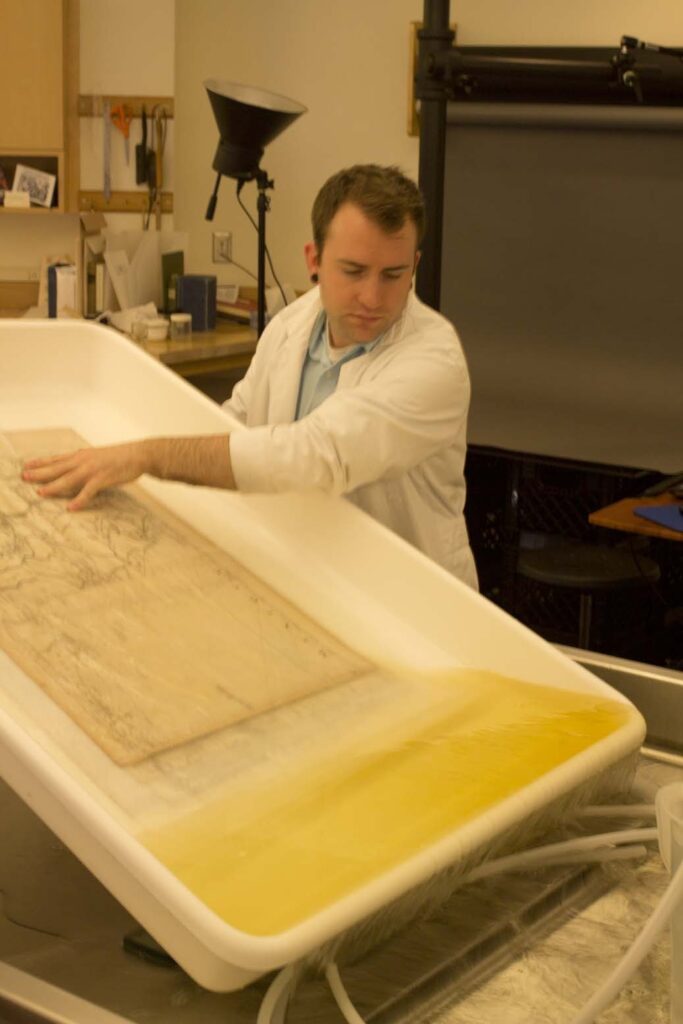
Fellowship Year: 2012-2013
What initially drew you to bookbinding and NBSS?
I pretty much grew up in libraries because my mother was a librarian. During undergrad as a studio arts major, I was introduced to conservation in a book arts class and decided to become a library conservator. I heard about NBSS through alum Chela Metzger BB ’93 and knew that after I completed my library science degree at UNC Chapel Hill, I needed to spend time developing my hand skills.
What did the fellowship mean to you? How did it prepare you for your future?
The fellowship was the perfect opportunity for me to learn skills that you can only learn on the job, under the supervision of a professional conservator, which prepared me for the next steps of my career. It opened my eyes to all of the working parts of a conservation project—meetings with curators, documentation, input from collection managers. Most importantly, it allowed me to work on complex projects that helped me understand the decision-making process and use my time, resources, and treatments most effectively on an individual basis.
Do you have any particularly impactful memories of the fellowship to share?
First, the daily staff coffee break at the Athenaeum was one of the most unique parts of an institutional culture that I’ve experienced to this day. Each day, staff from across all departments would meet in the break room for 30 minutes to have tea (or coffee) and casually chat. It built camaraderie and enabled a natural cross-functionality that was really productive. Second, when the fellowship was complete, I wrote a letter to Lisa von Clemm to thank her for the incredible opportunity, and to my surprise, she responded. She expressed her genuine interest in supporting people doing this work, and the validation of that support has stuck with me ever since.
What are you doing now?
At the end of my fellowship, I accepted a position as a rare book conservator at University of Illinois. I spent several years there before transitioning to my current role as Conservator for Special Collections at Duke University Libraries, where I work with a team that supports all the needs of the university special collections.
Natalie Naor BB ’17
Graeme Whitelaw Fellow in Paper Conservation, Book & Paper Conservation, New York University
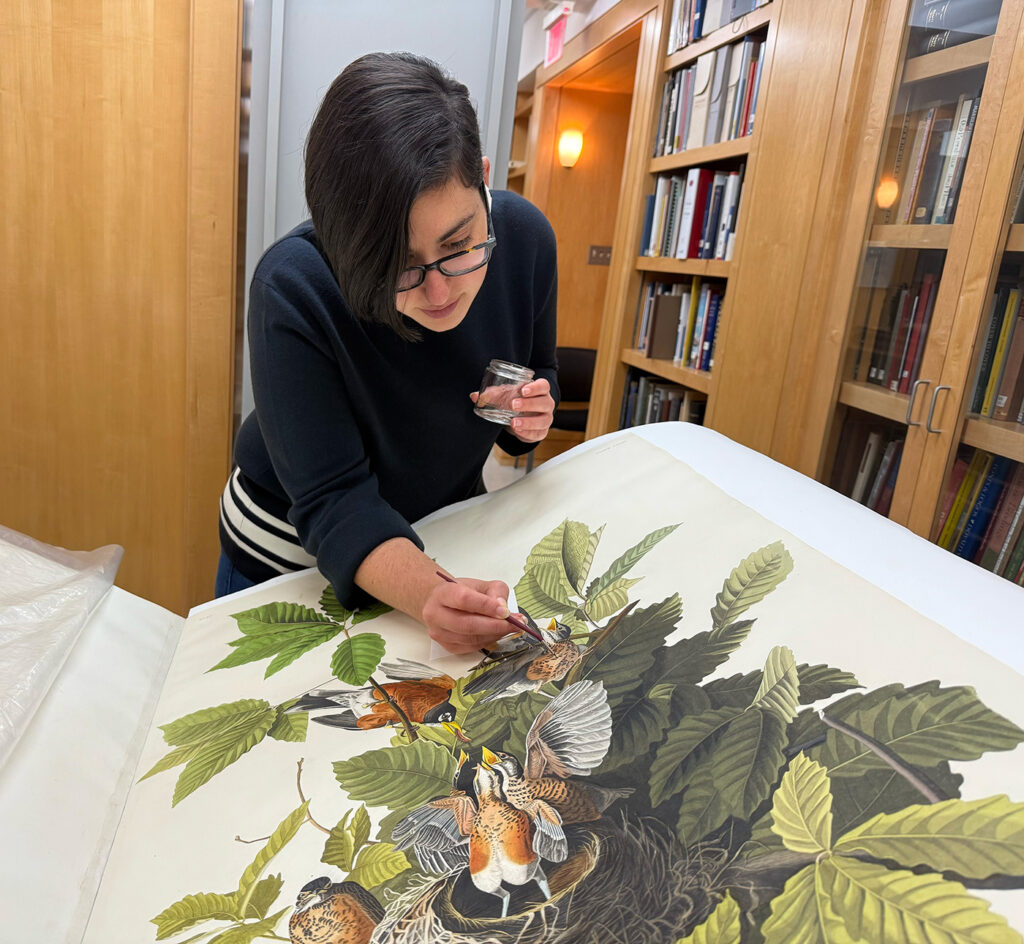
Fellowship Year: 2017-2018
What initially drew you to this field and to NBSS?
An undergrad degree in art history at Tufts University allowed me to pull together some of my many loves: books, history, and fine art. After a summer preservation internship in Italy, I knew book conservation was it for me. I had heard of North Bennet while already in Boston, and to me, it was worthwhile to first understand how books were made and function before learning how to fix them.
How did the fellowship prepare you for your future?
It gave me the chance to learn things that are very hard to understand unless you’re actually experiencing them firsthand. Not only are you performing treatments yourself, but you’re also documenting photographs, learning art handling, and discussing all of this with curators and other departments to make ethical, informed decisions. It allowed me to apply and build on the skills I learned at North Bennet and see why they matter in a wider environment. I got to witness the different hats that conservators wear within a larger but still intimate institutional context, which was invaluable to me as an emerging professional in the field.
What was your favorite project during the fellowship?
The rare book curator at the Athenaeum at the time had purchased a large collection of some interesting Victorian wax seals that were complicated to handle. I was challenged, in a good way, to devise a housing solution for it. I had to make it work for the seals themselves, the specific space where it was being stored, and for the future users who would handle and engage with them.
What are you doing now?
After my fellowship ended, I was a conservation technician at Columbia University Libraries for almost six years. The skills I learned at NBSS and the Athenaeum were used daily as I repaired circulating collections and made custom exhibit mounts and housings for special collections materials. I ultimately wanted to deepen my knowledge to include more of the science side and analytical instrumentation, so I went back to school. I’m currently a rising third-year in NYU’s graduate conservation program at the Institute of Fine Arts.
India Patel BB ’24
Temporary Conservation Assistant, Boston Athenaeum, current NBSS Bookbinding Teaching Assistant
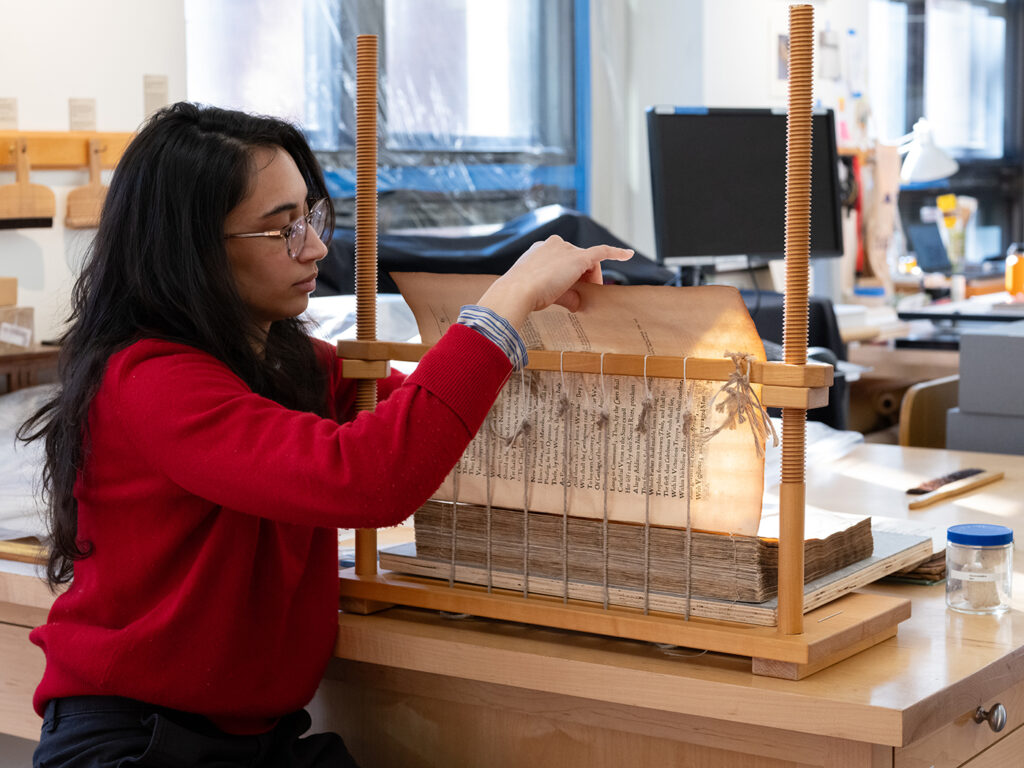
Fellowship Year: 2024-2025
What initially drew you to this field and to NBSS?
In college, I was introduced to special collections and archives, and the idea that you could study books as material objects seemed mind-blowing. While working in the bindery of a small publishing operation, I fell in love with the hand-skill aspect of the work. An intern there was an NBSS student, and she suggested the Bookbinding program.
How did the fellowship prepare you for your future?
The joy of the fellowship to me is defined by the range of experiences it offered. It’s really special—and important—that I got insight into collections care more broadly: things like humidity, temperature control, and understanding how institutions handle big projects. You get to work on so many different types of tasks, which means more treatment options, strategizing, and decision-making opportunities. Every book picks up different elements of disrepair over its lifetime, and getting to do this work repeatedly is how you get better at it.
What was your favorite project during the fellowship?
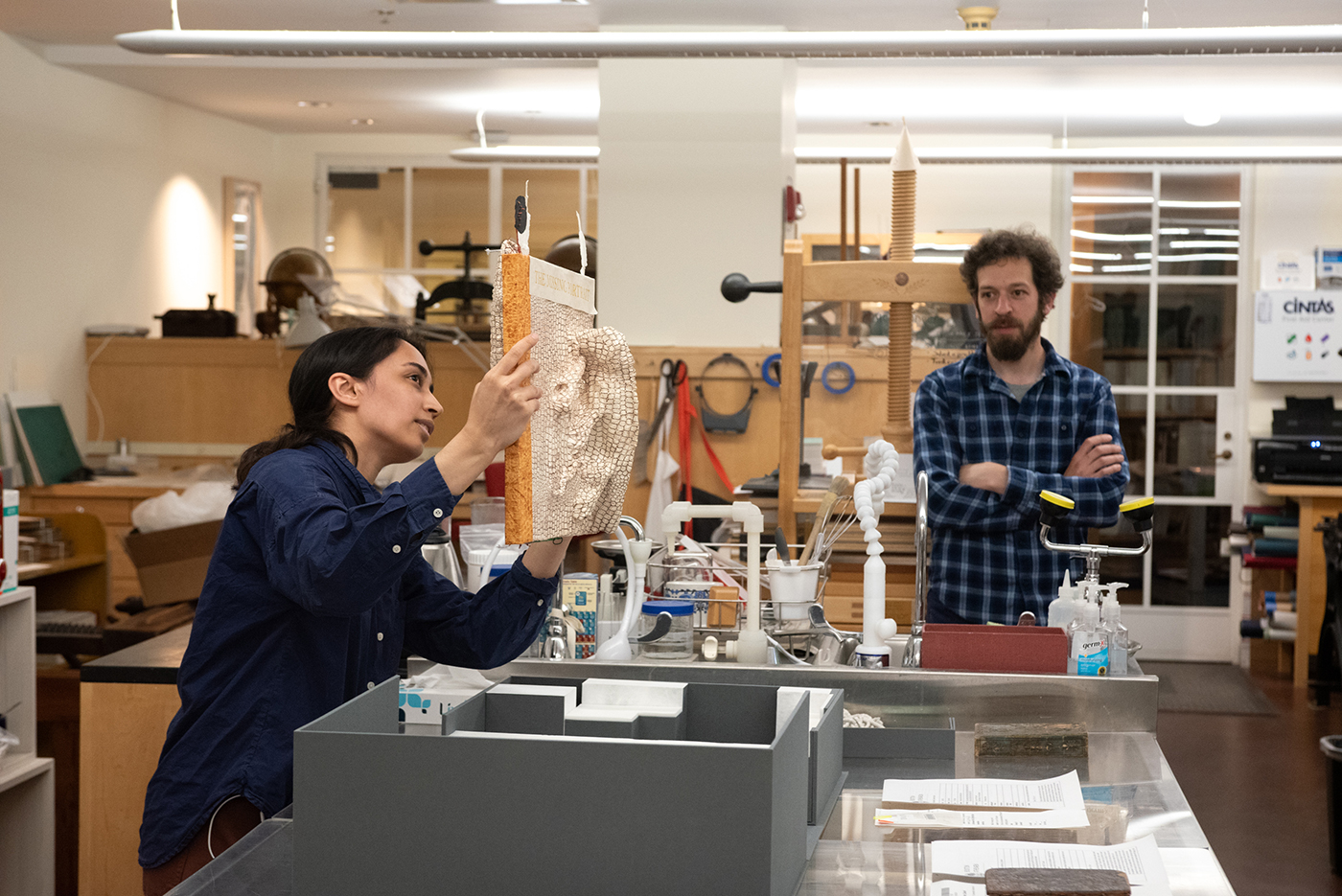
I built a clamshell box with all sorts of platforms and modifications for a 21st-century artist book with voluminous paper lizards on it. The box required quite a lot of thought and study, and I still can’t stop talking about it.
What are you doing now?
After I finished my fellowship last year, I rolled into a temporary conservation technician position here. I’m getting a chance to expand on the work I did during the fellowship while deepening my skills. Next, I’d love to be a conservation technician at an institution.
This story is from our Summer 2026 issue of Benchmarks magazine. Read more stories from the issue or view past issues.

